
‘Sangham’ of Cultures ~

In the first blog ‘A Beautiful Beginning’, I elaborated on all the unconventional steps we took as a couple to make our wedding personify our identities. Today I want to narrate the ‘Sangham of Cultures’ , we lived through the pre-wedding festivities. The word ‘Sangham’ predominately means the coming together or merging of two or more approaches. Even the meeting point of two rivers is known as a sangham; after which the two rivers merge into one.
Coming from two cultures, we curated a sangham of the two translating into a week full of traditions and blessings. I come from a part Maharashtrian and part Malayali household and my life has been an amalgamation of rituals from both cultures. We celebrate Makarsankrant- the mid -winter harvest festival, Holi- the festival of colors, Gudi Padwa - The Maharashtrian New year and Diwali- the festival of lights with the same enthusiasm as ‘Vishu ‘ - The Kerala New Year and Onam - the Autumn harvest festival! My mom always believed that if she celebrated both cultures, I would grow up to embrace ideologies that seemed meaningful to me — Unity in Diversity as we say!
Now you would be wondering how this has influenced my wedding? Allow me to explain!
Event 1: The Grahamak — My wedding week officially commenced with Grahamak; an auspicious pre-wedding ritual primarily observed in a Maharashtrian Brahmin household. The bride along with her parents and immediate family gather to perform yadnya - a sacred fire and offer prayers to invoke the Navagrahas (nine planets) and Lord Ganesha by creating a beautiful display and assembling relics of the Navagrahas, pouring offerings into the holy fire and praying to ensure that the upcoming celebrations are free of obstacles. I sat along with my parents and Simbaa my fur baby, surrounded by loved ones through the morning, wholeheartedly praying for prosperity, inner peace, clarity, and positivity for our new beginnings.
As part of the ritual, the ‘Mundawale’, a forehead ornament made from pearls woven into a thread is tied around the bride’s forehead by the ‘Karavali’ (typically the bride’s sister) as the Pandits continue to pray to Lord Ganesha. This ornament embodies readiness of marriage and spiritual focus. Additionally the two threads running parallel on both side of the face symbolises the readiness of an equal union and inseparable bond of the couple along with a lifelong commitment. I remember feeling emotional, but also feeling this non-existing burden of staying strong — for my parents because I could see the cloud in their eyes through the happiness; that heaviness every parent feels when their child is ready to spread their wings and take a leap! It took extra effort to focus on the moment as the silent battle occupied my thoughts.
I wore my mother’s saree draped in Navwari style for Grahamak; as an attempt to impersonate a Marathi bride. P.S— I forgot to wear a ‘Nath’ in the chaos of getting ready. This gorgeous blue saree was a gift from my father to mom for their wedding, 33 years ago! Another emotional embrace I wanted to carry forward on the first event of my wedding festivities!
This sacred morning quickly transitioned into a dancing fit once the Puja was successfully completed! We danced through afternoon until our feet hurt. My dearest pampered me by dancing around me in a circle and showering me with kisses one by one. We also played Fugdi, a traditional folk dance from the Konkan regions wherein women cross-handed hold one another and dance in circles like a merry-go-round- another Maharashtrian feature.
Once we concluded with a hearty meal, we gathered around our dining area for the next activity — collecting blessings from my elders in the form of red paint prints of their palms on my version of ‘phoolon ki chadaar’ (also known as blanket of flowers). This blanket is traditionally made of real or artificial flowers and is held over an Indian bride's head by her brothers and close male relatives during her grand entrance (bridal entry) to the wedding venue. In an attempt to translate this beautiful tradition into a tangible memory we customised the chadaar with an elegant golden net dupatta adorned with mirror work, a white border to hold the palm stamps and aesthetic kaleera & pearl tassels hanging from the corners. It not only symbolised the love, protection and promises pouring in from my loved ones but also captured their blessings in the form of hand-prints along with heart-felt notes written around it, which was then held over me as I stepped towards my new beginnings with my pillars beside me.
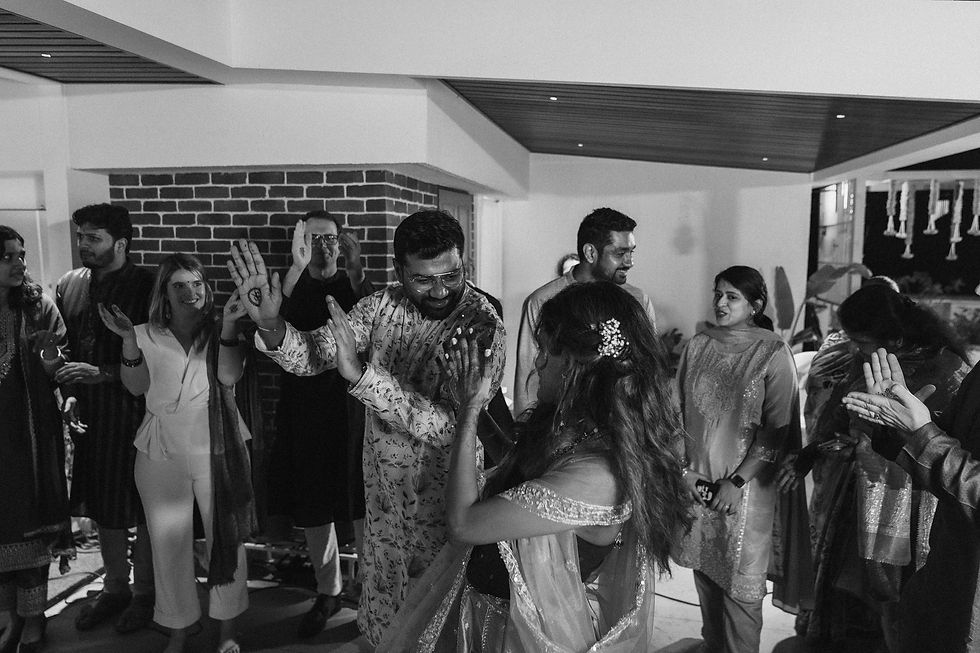
Event 2: Two days later we celebrated ‘The biggest mix’! We combined Mehendi (Henna), Maherchi Haldi (Maternal haldi celebration), Chudda bharni (Bangles ceremony ) and Arinurikal (also known as Thaleluraieduva) into one beautiful evening! Back story— I was keen on getting married at home on our terrace; which did not translate into reality, but we celebrated this evening at home exactly how I intended to. Around 85 closest family and friends filled our home with warm smiles and excitement (Yes! In an Indian setting this is what ‘closest’ looks like)! Of course Rohan came as well, with beautiful sunflowers for me (that coincidently matched with my outfit), and also brought his friends along, who had specially flown down from Europe to be a part of our wedding!
Now let me try to break down the evening for your imagination.
Mehendi - I already knew that I wanted minimalistic mehendi on my bridal hands and that made my Pinterest board filled with simple elements of Lotus, elephants and bells, which was transferred onto my palm beautifully. I was also sure that I did not want to be glued to my seat during the main event getting it drawn on my palms while my family and friends enjoyed the evening - hence I got mine done in the afternoon itself. Trust me - it was a game changer! I wore comfy clothes (a dress to be precise) sat in the most comfortable corner of my home and got it done as my mother, closest aunts and friends fed me, danced and watched over my shoulder. Many a times during a wedding, we forget to live in the moment, and the house is running in chaos; the bride’s mother is running around completing errands, her father is attending to the guests, uncles & aunts have designated duties to fulfil and the bride is living the moment alone; well aware of this we had decided early on that all my closest will be beside me through all the functions to live and experience them with me - and we successfully did so!
I chose to get ready by myself for that evening, choosing comfort over style! I wore an elegant but a light weight outfit, did up my face with my daily make-up and simply pinned my hair back from one side with tiny florals; and would you believe me if I told you that I was dancing around all evening ‘bare-feet’? — the only reason I woke up with happy feet the next morning. I got the cutest entry with Simbaa dressed in a pink kurta coming to receive me, as my family showered rose petals on me.
For decor, we stuck to traditional elements carrying relevance from both Maharashtra and Kerala. White & beige clay pots were used for floral arrangement, typical for a Maharashtrian household; the fairy lights dazzling the background were true to Diwali - the festival of lights; and the brass artefacts teamed with tall diyas (lamps) are significant to Kerala. For florals, we stuck to Nishiganda stems (Tuberoses) and combined them with yellow marigolds. It created the most beautiful corner for the amalgamation of our functions.
Bangle ceremony - A ritual deeply rooted in Indian culture, where the bride and the female members are gifted glass bangles as a celebration of their feminine energy. The significance of bangles is linked to womanhood, their marital status, and their femininity amongst other scientific benefits. Furthermore gifting bangles to women is considered auspicious as it represents presenting Devi (the Feminine power) with symbols of womanhood. We had arranged for huge selection of bangles that our guests could choose from with a cute potly bag to carry it back in.
Another part of the Bangle ceremony comprises of green glass bangles being sent for the bride by her in-laws; which my sister-in-law brought for me, and helped me wear them as per traditional customs.
Arinurikal - A Malayali ritual also known as Thaleluraieduva in most of parts of Kerala. In simple words it means blessing the bride and the groom by sprinkling rice grains over their heads, praying for abundance and prosperity. The spiritual importance of unhusked rice prevails through majority Indian states as it symbolises completeness, prosperity and is considered as presence of Goddess Laxmi, repressing wealth and peace. It is not only used to sprinkle as blessings but also placed in Kalash (vessels) to invite divine presence and to absorb sacred vibrations during prayers; hence if you notice in the image below it is a mandatory decorative element during this ritual — a huge brass vessel filled with rice grains till the top with a coconut flower or ‘Thennampoo’ rooted into it. This Thenanampoo represents prosperity, new beginnings and fertility. Ideally, basis tradition this ritual is done before the main wedding by the respective families of the bride and groom separately and once more after the wedding ceremonies to bless the married couple together. In our case, even though Rohan was present, I sat alone as the elders of my house bestowed their blessings on me by sprinkling little amounts of rice grains on my head, shoulders, knees and feet - top to bottom. My mother repeated this ritual for both of us on the day of my ‘Bidaai’ before we left for Rohan’s hometown after the wedding as well.

Maherchi Haldi (The Maternal Haldi Ceremony)- According to Maharashtrian culture the bride is treated with a ‘Maherchi Haldi’ to protect her from evil eye and negativity before the wedding. After Arinurikal, my mother along with my aunts applied haldi (Vicco Turmeric in my case as I have sensitive skin) as is customary, praying for my well-being and eliminating any negativity or nazar. It was a small affair as we did not intend on playing with the Haldi and quickly moved onto the next agenda of the evening!
We also had a compact Haldi celebration at the Venue just before the engagement evening, which took place in a Marwadi setting basis my mom-in-law's wish! Rohan and I sat beside each other while our families applied haldi to us (again Vicco Turmeric in my case)!

The guests were treated to an expert adorning their hands with henna, getting bangles that matched their outfits, enjoying chaat and most important of all, experiencing traditions!
The evening continued with good food, loud Bollywood music, lots of dancing, giggles and crazy fireworks!! Yes, fireworks! My father along with my kaka (his younger brother) burst the wildest fire crackers that day in honour of the wedding celebrations! All in all, this evening truly was the most wholesome embrace I could ever ask for — it was fulfilling, emotional, filled with love and warmth that I cannot express in words — and yet I tried!

Comments